
Women affected by breast cancer have new hope in the form of a nanotechnology-based drug that promises early identification and effective treatment of the disease. “Researchers have been working on finding new ways that could help patients fight breast cancer. Nanotechnology is the latest, which could bring a revolution,” said Harsh Dua, senior consultant in the Oncology Department at the Apollo Hospital. He said researchers in India are now able to develop a drug that is “more effective and comparatively more safer.”
The drug, a “nanoparticle formulation” of the anti-cancer drug Paclitaxel, promises new hope to thousands of breast cancer patients. In India, at 1.4 lakh, cervical cancer is the most widely reported. This is followed by cancers of the breast (80,000) and mouth (70,000). The drug would be injected into the patient during treatment, Dua said. “The nanoparticles in the drug shows preference for the tumour cell and chalks its own course. This helps because the other good cells are not affected and thus there are no side-effects,” he said.
The oncologist, who has been actively involved in the work, claimed the drug could be used to target any kind of cancer, but could prove more effective to combat breast cancer. “The drugs that are in the market currently have lot of side-effects like affecting the heart, damaging the nerve and depressing the blood count. But this drug has no such side-effects,” Dua said.
Describing breast cancer as a lifestyle disease, Dua believes that research activities in the country are the only way to bring the cost of the drugs down. “Cancer treatment is costly,” he said “The early advance in technology counts a lot. If it could cure one to two per cent of the cancer population. It will be wonderful.”


New gene linked to Alzheimer's identified...
Scientists said on Sunday they have pinpointed a new gene linked to Alzheimer's disease, the incurable brain disorder that is the top cause of dementia in the elderly. Abnormalities in a gene called SORL1 increased the risk for the disease, and this finding could help scientists develop new treatments, the researchers reported in the journal Nature Genetics.
The researchers looked at DNA samples from 6,000 people from four ethnic groups: Caribbean-Hispanics, North Europeans, black Americans and Israeli-Arabs. They found certain variations of SORL1 more often in people with late-onset Alzheimer's disease than in healthy people.
The late-onset form, affecting people age 65 and up, represents about 90 percent of Alzheimer's cases. The rarer early-onset form affects people from about age 30 to 65. Only one other gene, called ApoE4, has been identified as a risk factor for late-onset Alzheimer's. It was identified in 1993.
Several genes are linked with early Alzheimer's, and study of both types might lead to better understanding of how the disease begins and how to tackle it. Many scientists think Alzheimer's begins with the buildup in the brain of a gooey material called amyloid that clumps together to form plaques. That material stems from a protein called amyloid precursor protein, or APP.
SORL1 controls the distribution of APP inside nerve cells of the brain. When working normally, the gene prevents APP from being degraded into a toxic byproduct called amyloid beta peptide. When SORL1 is deficient, it allows more of the bad amyloid beta peptide to accumulate, fostering amyloid plaques. Alzheimer's is a complex disease that gradually destroys a person's memory and ability to learn, reason, make judgments, communicate and carry out daily activities. Scientists have struggled to understand the biology of the disease and its genetic and environmental causes.
PIECE OF THE PUZZLE
"It's another clue to the way in which this disease comes about, another piece of the puzzle," Dr. Peter St. George-Hyslop, director of the Center for Research in Neurodegenerative Diseases at the University of Toronto and one of the key researchers, said in a telephone interview. "Every time you get a piece of the puzzle and you can relate it to something else in the puzzle, you're that much closer to knowing what the picture on the puzzle is," he added.
St. George-Hyslop said it is premature to say what percentage of cases of late-onset Alzheimer's disease can be attributed to SORL1. ApoE4, which also may be involved in the production of amyloid plaques, has been linked to about 20 percent of late-onset Alzheimer's cases. "This appears to be the fifth Alzheimer's disease gene, and there are likely to be other important genetic variants that need to be identified before the entire picture is complete," Dr. Richard Mayeux of Columbia University Medical Center in New York, also involved in the research, said in a statement.
The disease first affects parts of the brain controlling memory and thinking, but as it advances it kills cells elsewhere in the brain. Eventually, if the patient has no other serious illness, the loss of brain function will prove fatal. Researchers from Boston University and the Mayo Clinic College of Medicine in Jacksonville, Florida, also took part in the five-year study.
Tiny robo to tread through spine
It has been a stuff of science fiction, compressing something to microscopic size and making it travel with blood flow in the human body. In the film Fantastic Voyage, a underwater vehicle was shrunk to microscopic size and injected into the blood vessels.
Now, a team headed by Moshe Shoham of Haifa’s Technion has created a propulsion system for a miniature robot to travel through the spinal canal, powering through cerebrospinal fluid, reports livescience.com. Shoham is also the primary developer of the SpineAssist robot to aid surgeons in performing delicate spinal procedures. The requirements for a robot that moves through body cavities are strict; it must be small enough to move through the body and it must have apropulsion system that is flexible enough to work.
Devices like the PillCam, a pill-shaped camera that is swallowed to picture the complete digestive tract, are moved along by the body’s own peristalsis, and do not need their own propulsion system. “The first location we’re targeting is the spinal canal—which means the device will travel through the cerebral spinal fluid (CSS) which is clear and similar to water. It doesn’t flow too fast, but it needs propulsion,” said Shoham.
“Now we have the propulsion system, but we still don’t have the actual payload —whether it’s a camera from images, or a subsystem which would take a biopsy — that’s still in the development stage.” The robot would in essence be a freeswimming endoscope; a robot with two actuators — swimming tails — that will have a camera in the head to broadcast images to the physician outside. “This is a unique swimming mechanism that is adapted to tiny sizes and, with very low power consumption”, the Technion researchers explain. “In the future, we hope that the robot will also be able to perform biopsies and release medications for local treatment.”
Shoham estimates that it will takeseveral more years to complete the design of the robot’s payload and to further miniaturise the design. He remarks: “I believe that in the future there will be micro-robots that will be permanently implanted in our bodies and will be able to navigate to problematic points. This is a step up for micro-penetration into the human body.”
Waltz your way to a healthier heart
Johann Strauss Jr died in 1899 at age 73 of pneumonia, not a heart attack, and that may be due to his “Blue Danube Waltz” and his many other heart-healthy waltzes. Did that make Strauss the Richard Simmons of the 19th century? Well, maybe not, but Italian researchers have come up with a novel way for cardiac rehabilitation patients to exercise hearts without having to squeeze into spandex or gyrate in a gym: waltzing.
The dance proved to be just as effective as bicycle and treadmill training for improving exercise capacity in a study of 110 heart failure patients. Dancers also reported slightly more improvement in sleep, mood, and the ability to do hobbies, do housework and have sex than the others. “This may be a more effective way of getting people to exercise, and may be more fun than running on a treadmill,” said Robert Bonow, cardiology chief at Northwestern University School of Medicine. “Maybe we should try here. I’m not sure we can get Americans to waltz, but they can certainly dance.”
Exercise is crucial after people suffer heart problems, but getting people to stick with it is tough. As many as 70% drop out of traditional programmes, said Romualdo Belardinelli, director of cardiac rehabilitation at Lancisi Heart Institute in Ancona, Italy. “We have to find something that may capture the patients’ interest,” he said at an American Heart Association meeting in Chicago where he presented results of his study. They chose waltzing because it is “internationally known” and is quite aerobic, as the study ultimately verified, he said.
Even 30 minutes delay can hike death risk by 42%
Hundreds of hospitals around the country are joining the most ambitious project ever undertaken to give faster emergency room care to people suffering major heart attacks. Fewer than one-third of such patients now get their blocked arteries reopened within 90 minutes of arrival, as guidelines recommend. The risk of dying goes up 42% if care is delayed even half an hour longer.
“There’s a very, very large opportunity here to improve patient care,” said John Brush, heart specialist who helped the American College of Cardiology design the new project. Major medical groups and government agencies have endorsed the project, including the National Heart, Lung and Blood Institute, whose director, Elizabeth Nabel, called it the biggest heart care initiative since paramedics were trained to do CPR.
It targets heart attacks caused by a total or near-total blockage of a major artery that prevents enough oxygen from reaching the heart tissue. About a third of the 10 million worldwide are of this type. The preferred remedy is angioplasty, in which doctors snake a tube through a blood vessel in the groin to the blockage. A tiny balloon is inflated to flatten the crud, and a mesh scaffold called a stent usually is placed to prop the artery open. Guidelines have long called for a “doorto-balloon” time of 90 minutes, “but we just haven’t engineered our ERs to cut out some of these steps that aren’t needed” and cause delays, Nabel said.
Stem cell vaccine to kill lung cancer
Embryonic stem cells, the controversial and versatile cells that seem able to do
just about anything, have now expanded their repertoire into cancer prevention. A vaccine made from these cells shields mice against developing lung cancer under conditions thought to mimic the effects of smoking.
Safety concerns about injecting stem cells into humans mean that regulatory agencies are unlikely to approve human tests of the vaccine, says lead researcher John Eaton at the University of Louisville in Kentucky. Nevertheless, he thinks the vaccine is worth testing in people at high risk of developing
cancer, such as heavy smokers or people with certain genetic mutations.
Other researchers are more cautious. Cancer vaccines, particularly vaccines made from cells, are notoriously more effective in mice than people, says Jeffrey Weber, an immunotherapist at the University of Southern California in Los Angeles. “The idea is interesting, but the execution may be impossible,” he says.
But both Weber and Eaton agree that the finding could lead to new ways to prevent or treat cancer. Eaton’s approach was inspired by the similarities between embryos, embryonic stem cells and tumours. “Embryos and tumours both grow as balls, they derive nutrients from the host, and they both express peculiar proteins—some of them in common,” he says.
These shared proteins made Eaton think that a vaccine prompting an immune response to embryonic stem cells would also trigger an attack against tumours. He and his colleagues injected mice with stem cells and gave the mice a booster shot ten days later. The researchers then transplanted lung cancer cells under the animals’ skin — a standard animal model for the disease. The stem-cell injection protected 20 out of 25 mice from developing tumours, whereas tumours grew in all unvaccinated mice. “We were absolutely shocked,” Eaton says.
Even more effective was a mixture of stem cells and cells engineered to make a molecule that stimulates the immune system. None of the mice given this vaccine developed tumours when implanted with cancer cells.
Software calculates heart attack risk
Pioneering computer software is helping doctors to decide how best to treat patients admitted to hospital with heart attacks. An international consortium of researchers, led by the University of Edinburgh, has developed a programme that enables doctors to swiftly assess the severity of a patient’s condition. The new ‘risk calculator’ is already being used in UK hospitals.
Doctors using the new system take key data from patients at their bedside, and input it into the specially-devised programme.
Key facts—such as a patient’s age, medical history and blood pressure—are recorded by doctors, as well as information derived from on-the-spot blood samples and kidney tests.
The new patient’s statistical profile is then input into a computer and matched with data derived from thousands of other coronary cases. Using the outcomes of these previous cases as a guide, the computer will not only give an accurate assessment of the new patient’s conditions, but also recommend possible treatment. Significantly, it will be able to predict the likelihood the patient suffering a heart attack, and even their chances of dying in the next months.
Chest pain accounts for more than a quarter of all emergency medical admissions in the United Kingdom. Spotting high risk heart patients quickly can be difficult, but Professor Keith Fox, of the University of Edinburgh, says the new tool will help: “Identifying those with threatened heart attack from the very many patients with chest pain is a real clinical challenge, but critically important in guiding emergency and subsequent patient care. Higher risk patients need more intensive medical and interventional treatment.”
An international group of cardiologists and statisticians have spent several years producing the Global Registry of Acute Coronary Events (GRACE) calculator. The complex statistical model has been developed using data derived from six-year study of more than 40,000 coronary patients worldwide.
Deadly LEAD
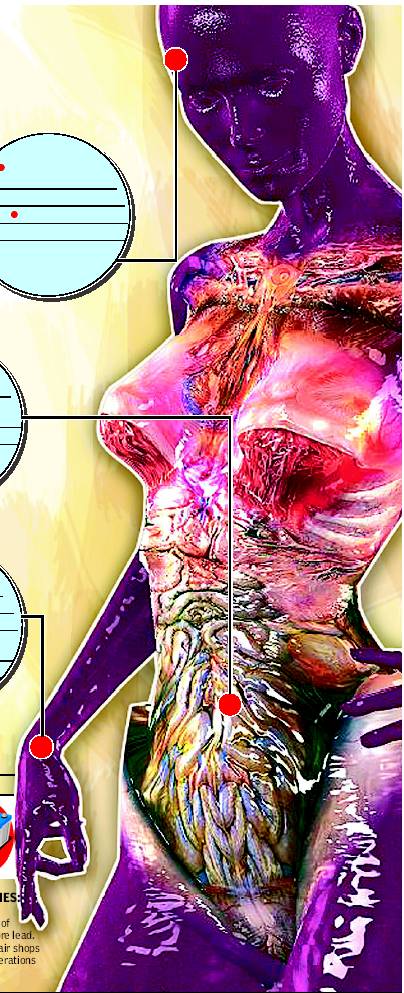
Lead poisoning occurs when a person swallows, absorbs or inhales lead in any form. The result can be damaging to the brain, nerves, and many other parts of the body. Acute lead poisoning, which is somewhat rare, occurs when a relatively large amount of lead is taken into the body over a short period of time.
DANGERS OF LEAD
It isn’t biodegradable. It persists in air, soil, drinking water and homes. It is particularly harmful to the developing brain of foetuses and young children. The higher the level of lead in a child's blood and the longer this elevated level lasts, the greater the chance of ill effects.
CHILDREN
Hyperactivity and aggressiveness Impaired growth and IQ Poor hearing Learning difficulties Damage to the brain and nervous system up to the age of 4.
PREGNANT WOMEN
Pre-term delivery Increased frequency of miscarriage, stillbirth Low birth weight Harms mental development of the foetus ADULTS Loss of appetite, anaemia Loss of libido, infertility Weakness of the limbs Aggressiveness, high BP and seizures Skin Cancer Joint Pains.
Subscribe to:
Posts (Atom)